


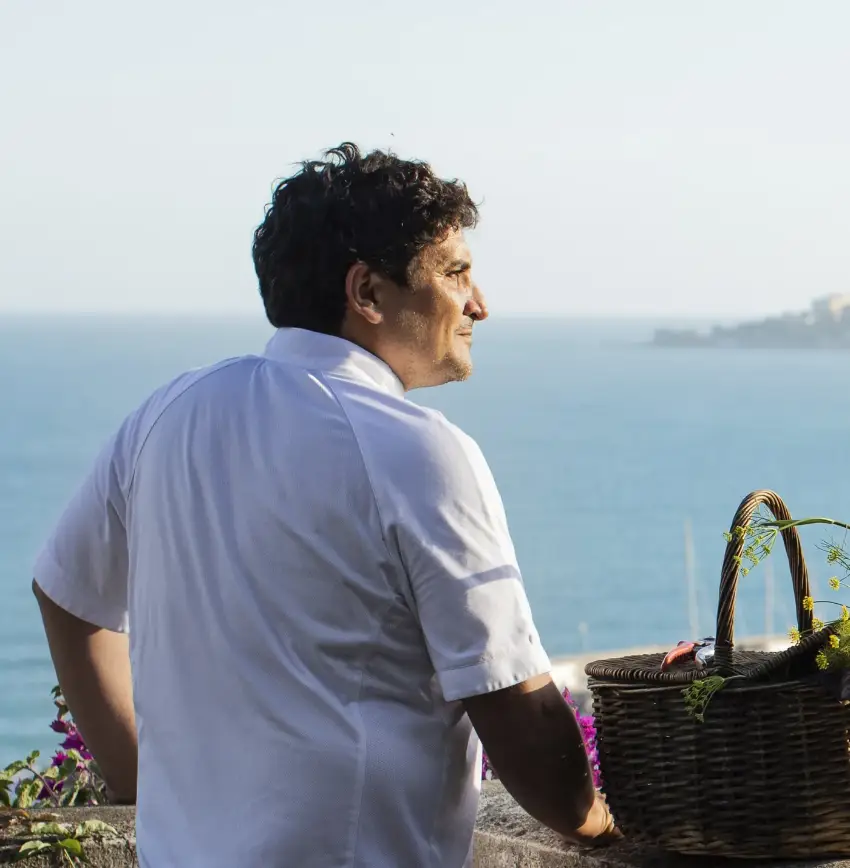
« In France, we are very fortunate to have this extraordinary diversity of exceptional products. Let's keep her! »
A flagship, tri-toilete establishment celebrating its twenty-year anniversary in Menton, Mirazur, restaurants in Paris, London, Tokyo, Hong Kong, Palm Beach or Bangkok, a brand of durable burgers in La Plata, its hometown in Argentina, a committed pizza shop, a bakery... Mauro Colagreco, appointed UNESCO Goodwill Ambassador for Biodiversity in 2022, is on all fronts.
Every time we eat, we choose the world we want to live in.
Mauro Colagreco
Affirms this immense cook and very committed chef. These are not just nice words: Mirazur was the first restaurant in the world to obtain Plastic Free certification (in 2020) and the first three-star to obtain the B Corp Best Practices label (in 2024). As close as possible to nature and those who cultivate it, Mauro Colagreco is today the sponsor of the 2026 edition of the « Chefs in Saint-Tropez celebrate regional producers and know-how ». Meeting with a man who talks to trees, shares strawberries with slugs and advocates virtuous cuisine.
Argentine childhood, cooking at the centre of family life
The Culinary Review — You were born on October 5, 1976 in La Plata, Argentina. In what kind of family and with what approach to feeding?
Mauro Colagreco — I'm celebrating my 50th birthday this year. I had the chance to be born in a setting where cooking was at the centre of family life. Everyone knew how to cook, by the way. My mother was notary and despite a busy schedule, she found time to feed us with beautiful dishes. My father, for his part, enjoyed himself on weekends and made dishes, pastries, like his strudel, which he himself made. As for my grandparents, who came from Europe, they had a real sensitivity to the Italian and Basque cuisines they mixed with Argentina's tradition of meat. It was a very Latin culture: the door was always open. The reception, the conviviality and above all the sharing were inculcated from my youngest age.
LRC — You were a greedy child?
Mr. C. — Gourmand? Yes! I've never had a food refusal problem [laughs]! I knew the happiness of being spoiled. My grandparents had a culture before and after the war: we had to welcome the other around something to eat. If we didn't eat... It was that there was a problem, that we were sick.
LRC — Do you preserve memories of iconic family dishes?
Mr. C. — My father's famous strudel... Who was even served at the Mirazur! The first few days after the restaurant was opened, when he came, I asked him to cook it. And my mother's gnocchi! As I was the last of four siblings, I often stayed with mom while my three sisters were in college. Because she had work to do, she moved next to her on a small bench to shape the gnocchi. They were then served with a family tomato sauce, simple, fragrant, very, very good. It's really my favorite childhood dish, my Proust madeleine.
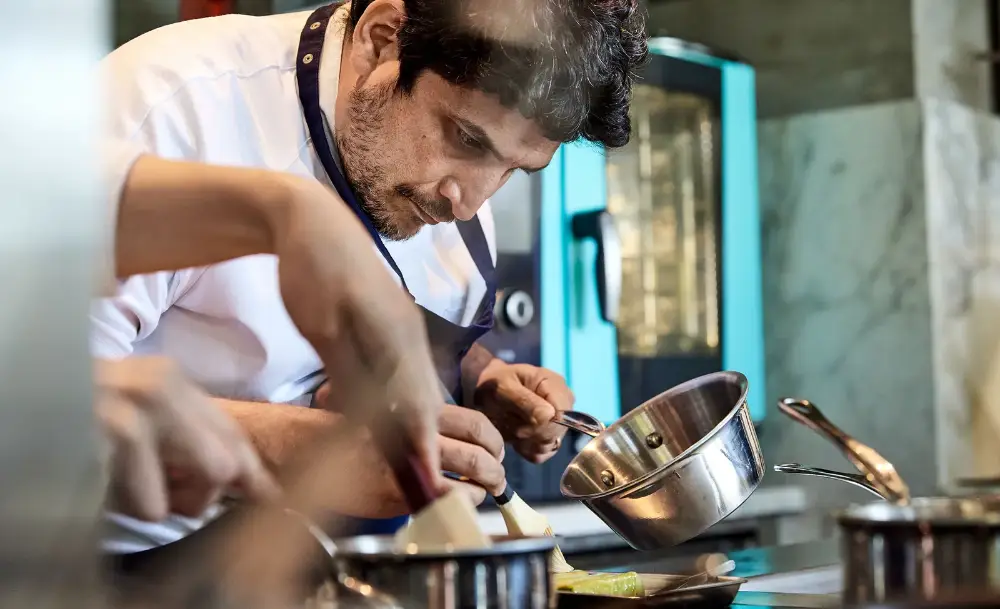
From La Plata to La Rochelle: the chance of a vocation
LRC — When and why were you destined to be a cook?
Mr. C. — It's almost random! Dad, an accountant, had a well-known firm in La Plata. None of my sisters turned to these studies, so they did not want to take over the firm. I thought it was a shame, especially since Dad was 14 years old, had us work at home for our pocket money. He wanted to teach us the culture of work. At the time, I found it very painful... Today I know it was very smart [laughs]. So I followed three years of university in economics-management-accounting with the prospect of succeeding him. I quickly realized it wasn't my thing! But it was a weight for me and I was delaying the time to tell him. When I finally decided, he exclaimed: « I was waiting for you to tell me! I understood that this was not your way! » And he always supported me afterwards.
So I knew what I didn't want to do... But I had no idea what I wanted to do! As I was still proud and wanted to be independent, I asked a friend who had a restaurant in Buenos Aires to hire me. I was already cooking a lot, but not at all professionally. From the first day in the kitchen, it was lightning! Three months later, I joined a catering school. And when I was 23, I came to France.
LRC — You have worked, among others, with Bernard Loiseau, Alain Passard or Alain Ducasse... a few words about the legacy « Products and Producers » Of these huge leaders?
Mr. C. — These are three chefs with very different culinary approaches and style, but they share the passion of the products, the respect of the producers and the desire to highlight them. It is the most beautiful and the greatest legacy they have left. This consideration for those people who allow us to do our job thanks to their know-how and quality products. In France, we are very fortunate to have this extraordinary diversity of exceptional products. Varieties specific to each region, to each micro-terroir. Let's keep them!
LRC — You already had this approach to the product when you arrived in France?
Mr. C. — I was educated like that. My grandfather was not reluctant to travel 300 kilometres to pick up the quality pig he wanted for the holidays or to travel from Uninel, his city in the province of Buenos Aires, several hundred kilometres away, to buy his many spices that could not be found anywhere else. I regained this taste for quality, very marked, in France. Wherever I go, there is a market and local producers. A treasure that must be preserved!
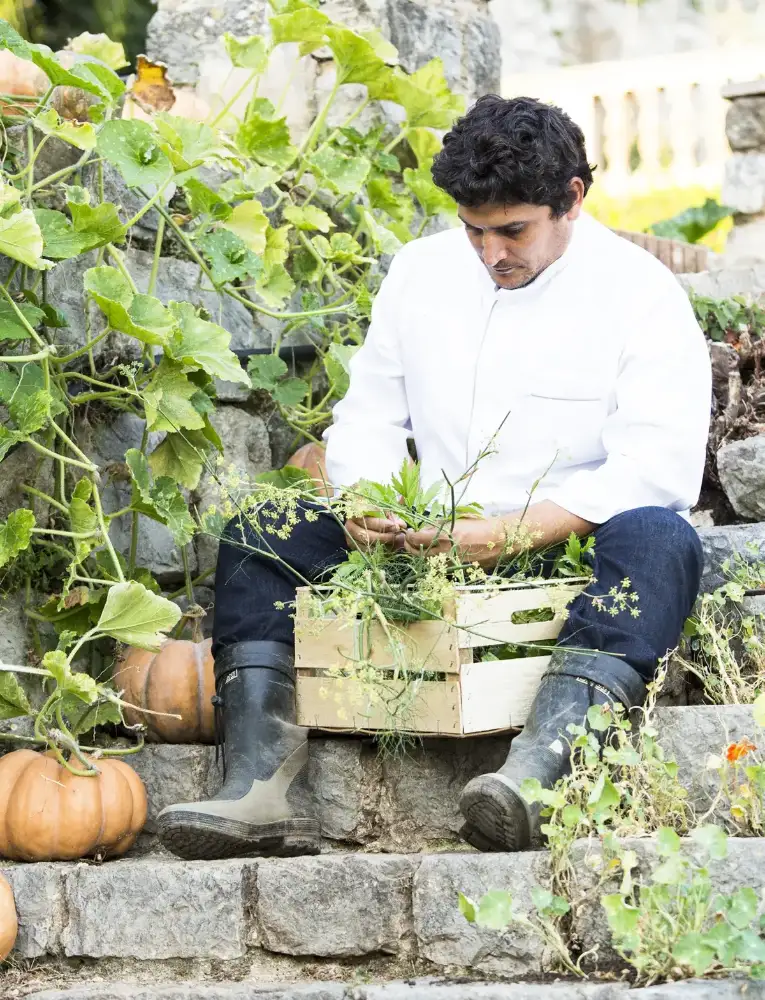
LRC — Memories of some of your first contacts and complicity with producers?
Mr. C. — I studied in La Rochelle where I kept an indelible memory: every Saturday on the market, there was a baker who made a brioche of Vendée: I've never eaten anything so good! I went religiously every Saturday! Then, at Bernard Loiseau's, I was very curious about everything. I had a notebook where I recorded receipts, but especially the names and telephone numbers of the suppliers. I knew that the quality of a dish was not just a matter of technique, but of the product. From the beginning of the Mirazur, I collaborated with a producer who is on the other side of France, in Rives-du-Couesnon, Brittany: it is Annie Bertin and her wonderful herbs, her vegetables too. For twenty-five years I have been amazed by its products. We always work together and I love him very much.
22 hectares of gardens and 150 suppliers
LRC — Today, in Mirazur, you grow 5 hectares of garden. Still using producers and artisans?
Mr. C. — At Mirazur, we now have 22 hectares. Last year we took over an abandoned 17-hectare farm in Sospel. But our will is not at all self-sufficient. We have Mirazur, Casa Fuego our Argentinian grill, Pecoranegra, our local pizzerias, Mitron Bakery, our bread bakeries and, recently, a beach restaurant, La Spaggietta di Balzi Rossi. On the one hand, we do not have the production capacity to supply these various establishments, and on the other hand, our producers are doing remarkable work, and with some we have established a friendship for twenty years. I built Mirazur with these people. I was one of the first, like Pascal Barbot in Paris, not to propose a map. Just a carte blanche menu: the only way to work according to the daily offer of its producers, its small fishermen. These people must be preserved, the product of their work and these invaluable human relations.
Circular gastronomy, a virtuous cuisine
LRC — You're very invested in what you call « Circular gastronomy », a cuisine in accordance with a societal and environmental commitment, which preserves plant and animal biodiversity. How was this strict and demanding involvement born?
Mr. C. — We have been so far away from nature, from life. Last week, one of my neighbors shot down a century-old tree that masked his sight of a little piece of sea! I come from a culture where we have the « Pachamama »Mother Earth, whom we worship and thank at every moment. So I was looking for farming types with meaning. We practice biodynamics, but with some freedom. We try to understand each ecosystem. We have six gardens at different altitudes, locations and climates. None of them work the same way.
For example, we produce strawberries. Even some organic producers cover their soil with plastic tarpaulin to preserve fruits from pests. It is said that strawberries are the beginning of a forest: the first strawberries, from the ground, will be tasted by the small slugs. But then the higher strawberries will be for us! Except that man wants all the strawberries [laughs]! We try to understand why pests have settled there, how to reduce their population without eradicating them at any cost. We want to get closer to other values, environmental, human, sharing. Feeding the other cannot be an exclusively commercial activity. If I bought all my vegetables elsewhere, it would have a much lower cost than the remuneration of my seven gardeners!
LRC — You grow in permaculture and biodynamics. A still unpopular agriculture, because small producers can't afford it?
Mr. C. — It is not a question of economic means. It is a question of will, education, search for other values. Do not want to be dependent on a linear and devastating economy for the earth, for ourselves.
LRC — Do you often go to your gardens?
Mr. C. — I love it! It's my moment of relaxation, of reconnection. My trees, I talk to them, I kiss them. We have trees more than a hundred years old, an olive tree of 800 years old! It takes three people's arms to walk around his trunk.
Sponsorship of « Chefs in Saint-Tropez » edition 2026
LRC — You agreed to be the sponsor of the 2026 edition of the « Chefs in Saint-Tropez celebrate regional producers and know-how ». Why?
Mr. C. — It's an honor and I'm proud of it. It is an annual event to the glory of regional producers, to their diversity. Our role as cooks is to be a vector of communication, to set an example, to show the way to a love of the earth and respect for those who cultivate it. Buying from local producers, not products that are not known where they come from or how they are grown, is also circular gastronomy. The money invested in short circuits stays here. This circulation too is paramount. It is essential to highlight all these producers, these artisans. They are people who continue to believe in quality, fine work, exceptional products. And that, with fervour, passion and no cheating! We have to help them!
LRC — Can you tell us a few of them?
Mr. C. — At Mirazur, we work with 150 suppliers! So I would just mention Audrey Angelica, founder of Tagète et bergamote, a company that connects a whole network of producers engaged in the service of the chefs by avoiding to both parties the logistical and administrative constraints of their exchanges.
Farm-inn-school in Sospel to transmit
LRC — Finally, you are very attached to the transmission and the young people who will become the cooks of tomorrow. You plan to open a « Farm-inn-school » Sospel...
Mr. C. — The project is still ongoing, but it has fallen behind. Many young cooks are no longer in contact with the product. When I was cooking with my parents, my grandparents, it wasn't a list of ingredients, then a process. It was a story, a season, notions of health, encounters... I lecture in food schools and I always ask this question: « How long does the onion cycle take to move from seed to the gross product we cook? » Over the last ten years, I've had one good answer! In Sospel, it won't really be a school. We will have conventions with establishments for kinds of master's over eight months where we will teach young professionals to cook from farm products. A virtuous kitchen.
Interview by Valérie Bouvart.
The Culinary Review No 961, May/June 2026.